


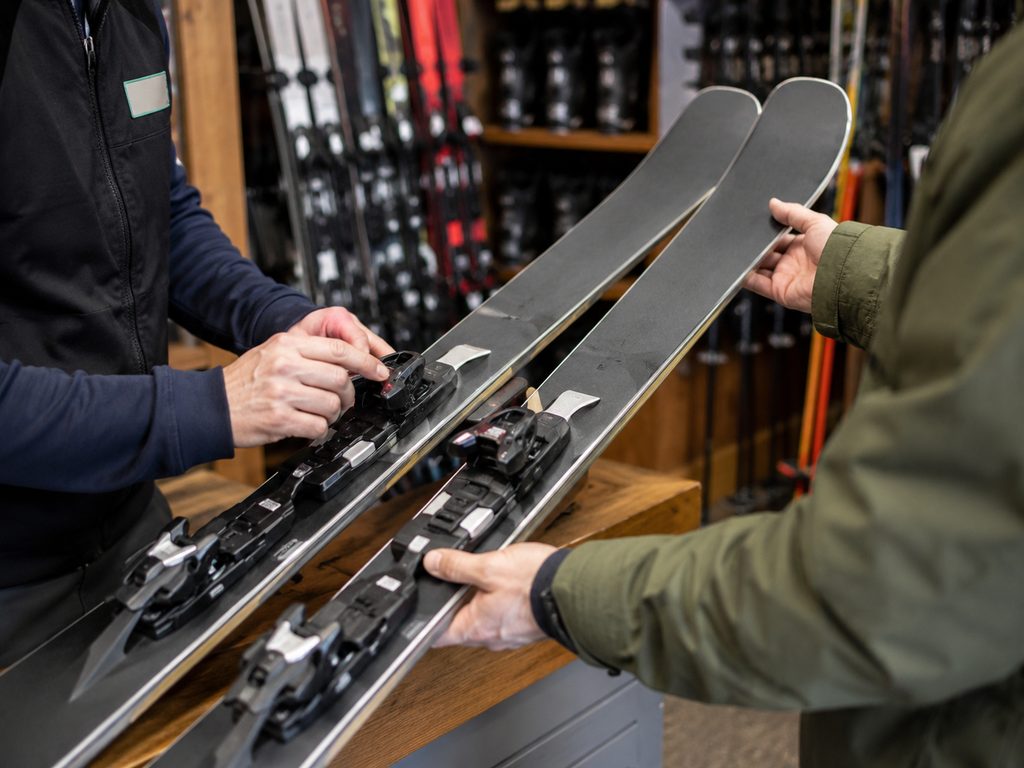
Buy or rent skis? Owning your own skis only pays off once your total rental costs overtake the purchase price – in our current price examples, that happens after 18 to 48 booked rental days. If you’re torn between buying and renting before your next ski holiday, you probably want one clear number of days. It exists – just not the same number for everyone. What matters is what you compare, what your whole rental period costs and how often you’ll actually use the gear.
The popular “daily rate times ski days” sum doesn’t cut it. Six rental days often cost less than six single-day rentals. To compare fairly, you need to work with the total price of the actual rental period. For many skiers, that changes the point at which buying makes financial sense.
Buy or rent skis: the short answer
Renting skis is usually the easier choice if you only ski now and then, your next ski holidays aren’t fixed yet or you’d rather travel without your own gear. Buying skis gets more interesting if you ski regularly over several seasons, your ability level is stable, you know exactly which skis suit you, and transport and storage are easy to sort out.
In between sits an often very good option: your own, properly fitted ski boots with rented skis. You keep the fit and familiarity on your feet but stay flexible with the bulkiest part of the kit.
Buy skis, rent them or mix both?
Before you start crunching numbers, take a look at how you actually ski. The cheaper option isn’t automatically the more practical one – and sometimes a little extra comfort is worth more than a theoretical saving.
Lean towards renting
If you’re a beginner, ski irregularly, travel by train or plane, like trying different categories and models – or fancy switching to a snowboard now and then.
Lean towards buying
If you ski often and predictably, have a settled skiing style, know your gear and are happy to handle servicing, transport and storage yourself.
Own boots, rental skis
If fit and familiarity matter to you, but you want to stay flexible with the skis and carry less bulky gear.
This isn’t meant as a fixed rule. A keen skier may still prefer to rent because they fly a lot or want to switch between slalom, all-mountain and freeride skis depending on the snow. Equally, someone with only a few ski days may buy because a familiar pair matters a lot to them.
Why the daily rate isn’t enough
A single rental price can hardly represent the market: prices vary by destination, dates, shop, category and what’s included. That alone makes a fixed standard figure too crude for a buying decision.
On top of that, longer rental periods aren’t necessarily priced in a straight line. The selection below covers four resorts in four countries. Each row uses the same resort, the same partner shop, the same category and the same type of customer.
| Country, resort and category | 1 day | 6 days total | 1 day × 6 | Effective per day | Cheaper than 1 day × 6 |
|---|---|---|---|---|---|
| Austria, Sölden · Economy skis | €17.85 | €95.20 | €107.10 | €15.87 | 11.1% |
| Andorra, Soldeu · Beginner skis | €16.40 | €87.20 | €98.40 | €14.53 | 11.4% |
| Italy, Breuil-Cervinia · Beginner skis | €12.75 | €63.75 | €76.50 | €10.63 | 16.7% |
| France, Chamonix · Beginner skis | – | €68.90 | – | €11.48 | – |
Non-representative selection of dynamic alpy.com online prices, retrieved on 8 September 2026 for one adult: 1 day on 21 January 2027 and 6 days from 20 to 25 January 2027. Skis and poles, without optional extras. For Chamonix, a one-day price was only available from a different partner shop than the six-day price, so that row has no direct comparison. The effective daily price is the total price divided by the rental days and is for guidance only.
In the three resorts with a directly comparable one-day price, the six-day package costs 11 to 17 percent less than six single days – in Sölden, for example, €95.20 instead of €107.10. That’s not a general discount rule; how steeply prices drop depends on the shop and category. But it shows why you shouldn’t simply scale a one-day price up to a ski week: here, that overestimates the cost by around 13 to 20 percent, depending on the resort.
What the online price means compared with the shop price
Alongside the total price, the offers show an in-store reference price – the amount the partner shop charges for the same gear over the counter. In the offers documented here, the online price was 15 to 35 percent lower, depending on the shop and country.
These reference values come from the same product card as the online price. They aren’t the same as a price checked independently at the counter, and the sample is too small for a reliable average. For your decision, only the total price you can actually book for your destination, dates and category counts.
How to compare buying and renting fairly
Plenty of seemingly precise break-even calculations fall apart at the shopping basket. If ski boots are included on the rental side but not on the buying side – or the other way round – the result tells you very little. So first check that both sides really cover the same thing.
- Define the scope. Are you comparing just skis, or the full ski equipment set with boots and poles? A helmet only belongs in the sum if it’s included on both sides.
- Stay in the same category. An economy rental ski is no fair match for a high-end performance ski. And “example model or equivalent” isn’t the same as a guaranteed model you buy.
- Use real total prices. On the rental side, the full package price including mandatory fees counts. List optional insurance, ski storage or model swaps separately. A refundable deposit isn’t a rental price.
- Flag special offers. A clearance price is a real purchase price, but not a permanently available market value. The same goes for dynamic online rental prices.
“Skis only” isn’t always exactly the same package
In the rental offers we looked at, “skis only” usually included poles. Skis you buy, on the other hand, often come with bindings but without poles. Small differences like these need to go into the sum – otherwise one side looks artificially cheaper.
How to find your personal break-even point
For a first estimate, you only need two numbers: the total price of the comparable gear you’d buy and the total price of your typical rental period. Divide the purchase price by the rental price per period. The result shows how many such trips the purchase price is worth on paper.
You book whole holiday periods, though. So next, check on which complete trip your cumulative rental costs first exceed the purchase price. If they’re exactly equal, buying isn’t cheaper yet – renting only becomes more expensive from the following trip.
An example with the same purchase
The rough calculation below only looks at purchase and rental. Servicing, transport, storage and any resale value come in the next step.
Let’s take a specific, documented mid-range all-round carving ski with bindings for €494.95 (2025/26 model). That’s a single offer, not a general market price; boots and poles would come on top. Compared with the documented premium rental ski in Sölden at €190.40 per six days, two trips add up to €380.80 in rental costs; after the third trip it would be €571.20. In this scenario, renting overtakes the purchase price on the third trip – after 18 booked rental days.
Compare the same ski with the beginner rental ski in Breuil-Cervinia at €63.75 per six days, and that only happens on the eighth trip: seven trips cost €446.25, eight trips €510.00. So the rental category and rate shift the threshold from 18 to 48 booked rental days – bearing in mind that a mid-range ski you buy is being compared with a cheaper rental category here.
| Buying vs renting | Purchase | Per trip | On paper | Pricier from | Rental days |
|---|---|---|---|---|---|
| Mid-range ski vs Sölden premium ski | €494.95 | €190.40 | 2.60 | 3rd trip | 18 |
| Mid-range ski vs Sölden economy ski | €494.95 | €95.20 | 5.20 | 6th trip | 36 |
| Mid-range ski vs Cervinia beginner ski | €494.95 | €63.75 | 7.76 | 8th trip | 48 |
| Race ski vs Sölden premium ski | €1,200.00 | €190.40 | 6.30 | 7th trip | 42 |
Purchase prices: documented single offers, as of 9 September and 3 August 2026; rental prices: as of 8 September 2026. The race ski represents the top end of the market. Calculated ski against ski; rental skis include poles, while poles and boots would come on top when buying. In the rows with economy and beginner rental skis, a mid-range ski you buy meets a cheaper rental category – if you rent in the same category, you reach the threshold sooner. Excluding servicing and resale value.
In these scenarios, the threshold falls between the third and eighth six-day trip – between 18 and 48 cumulative rental days. That range is not an industry benchmark. It only describes the combinations we looked at and can be very different with other purchase prices, categories and destinations.
What your own skis cost on top
The purchase price isn’t the end of it – and this item is regularly underestimated. Skis need servicing, transporting and dry storage. A standard service at an Austrian sports chain costs around €35 and makes sense roughly every five to six ski days; on top of that comes a bigger service every one to two years.
Over time, that adds up. With one ski week per season, you’re looking at roughly €200 over five years and around €320 over eight years – for servicing alone, on top of the purchase price. That’s why servicing is a visible field in the calculator rather than hidden among the extra options.
How often a service is really needed depends on snow conditions, skiing style, rock contact and your own standards. A fixed servicing allowance would therefore be just as arbitrary as a fixed lifespan. We couldn’t find a universally valid figure after which skis and bindings are automatically “expired”. Especially with older bindings, a specialist shop should check their condition and whether they can still be serviced; the manufacturer’s guidance takes priority.
Resale value, transport and storage
A flat resale value isn’t very reliable either – and if you count on one, you’ll often be disappointed. An example from the top end of the market: a race ski with bindings costs around €1,200 new, while a used model from the same line is listed on a classifieds platform for about €165. That’s around 14 percent of the new price.
Put the two side by side and you get an uncomfortable picture: over eight years, servicing can cost more than the skis are worth at the end. Model year, condition, edge and base material left, repairs and how you sell all make a big difference. If you don’t know a realistic resale value, calculating with zero is more honest than an optimistic guess.
For transport, it depends how you travel. In your own car, the skis might fit in at no extra cost. A roof box means buying one, higher fuel use and extra hassle. On flights, oversized baggage can make every trip pricier. If you travel by train, rental gear saves you the lugging. These points can’t sensibly be given the same euro value for everyone, but they belong in the decision.
Ski rental benefits that can be worth more than the price
Renting doesn’t just mean you have nothing to store or service. The practical advantage that doesn’t show up in any cost calculation is a different one: you’re not tied to one pair of skis.
Try things out instead of committing
When you rent, you can test. Over several holidays you can ski different categories – a narrow piste ski, a wider all-mountain ski, a sportier model – and find out what suits your style. If you buy later, you know what you’re buying. For beginners, whose ability changes noticeably from season to season, that’s often worth more than the price difference.
The right choice can even change within one trip. After fresh snow, a wider ski is more comfortable; on hard pistes, a shorter, more responsive one. According to alpy.com, swapping is possible at no extra cost from the higher equipment categories upwards. With your own skis, you ski whatever’s in the car.
Then there are services that make resort life easier: depending on the partner shop and package, a ski locker can save you carrying gear between your accommodation and the slopes every day, and some shops offer pick-up the day before.
What to check
These services are not included everywhere and not always free. In the offers we looked at, the conditions varied a lot. Swapping gear was sometimes only possible after two rental days, only once and within the same category; elsewhere it was shown as a paid extra. The scope and price of ski storage weren’t always listed either. So check before booking what’s included in the specific offer from your chosen partner shop. Which extra protection options are worth it when renting is covered in our guide to ski rental insurance and damage waivers.
The calculator above deliberately doesn’t put a euro value on these points – a flat figure would be made up, because their value depends on availability, weather and your own expectations. But they consistently favour renting and belong in the equation as soon as the result is close.
Your own ski boots with rental skis
If you only want to buy part of your ski equipment, ski boots are often the most sensible place to start. You feel fit, pressure points and power transfer with every turn. A properly fitted boot of your own stays familiar, while you rent skis to match the resort, your ability and the snow.
It also makes the cost calculation clearer: if you already own boots, you only compare the purchase price of the skis with a skis-only rental. If you’re buying new boots, look at their price separately. What matters is that the boot sole and binding are compatible and the rental shop adjusts the binding to your boot. What a good fit feels like is explained in our guide to ski and snowboard boot fitting.
Different priorities apply for children
With children, the limiting factor is often growth, not wear. Skis and boots can be too small long before they’re worn out. That shortens the realistic lifespan of a purchase – and the adult calculation loses its meaning.
For families, renting ski equipment is therefore often the more practical solution: the gear fits again every season, without outgrown skis gathering dust in the cellar. We didn’t systematically collect current children’s and family prices for this article, so specific flat figures would be misleading. Work with the time until the next size change, and only factor in reselling or handing down to siblings if that’s realistic for your family. What to look out for when renting for kids is covered in our guide to renting ski equipment for kids.
Why you find such different numbers of days
Some guides say five to ten ski days, others twenty, thirty or more. Often they aren’t even talking about the same thing. One figure means cumulative rental days until costs break even, the other means ski days per season over an assumed period of ownership. Add different purchase segments, one-day or weekly rates, servicing, resale value and travel costs.
For a decision today, current total prices for your own rental period tell you more than older sample calculations with prices you can no longer check.
The science behind it: the ski rental problem
In computer science, the question “rent or buy?” is known as the ski rental problem. It’s a classic example of an online decision problem: you have to act today, even though you don’t yet know the key piece of information – how long you’ll use the thing.
The classic model
In the simplest model, each unit of use costs a constant r, and buying once costs K. If the future period of use T were already known, the optimal cost would be C(T) = min(T × r, K). In hindsight, you’d simply pick the cheaper of the two sums.
Break-even on paper is at K ÷ r. If the result is a whole number, renting and buying cost exactly the same at that point; renting only becomes strictly more expensive with the next complete use. If the result isn’t a whole number, there’s no exact tie on any full day of use. Rental costs then first exceed the purchase price at ⌊K ÷ r⌋ + 1.
Hindsight and decision aren’t the same
The classic deterministic strategy rents first and buys once further renting would reach or exceed the purchase price. In the worst case, its costs are just under twice what a person with perfect knowledge would have paid. A randomised strategy improves the optimal competitive ratio to e ÷ (e − 1), or about 1.58. This analysis goes back to the work of Karlin, Manasse, McGeoch and Owicki on competitive analysis.
So the model answers not only the backward-looking question “When would buying have been cheaper?” but the harder one: “When should I buy if I don’t yet know how long I’ll need it?” That same uncertainty remains with ski holidays: a calculated threshold doesn’t guarantee you’ll actually reach it.
Why real ski rental differs from the model
The classic model assumes a constant price per unit of use. Real rental offers, by contrast, work with package prices, categories, set components and optional services. Research on non-linear ski rental and on multiple discount options therefore treats the linear basic model as just a special case.
For repeated identical rental periods with total price R and d rental days, after n trips: M(n) = n × R and D(n) = n × d. If the trips differ in length or price, you add up the actual package prices: M(n) = Σ Rj. An effective daily price calculated from this is a useful look back, but not a reliable forecast for a different package length.
Scientific basis includes: A. Karlin, M. Manasse, L. McGeoch and S. Owicki, “Competitive Randomized Algorithms for Non-Uniform Problems”, Algorithmica 11, 1994, 542–571.
Frequently asked questions
Is it cheaper to buy or rent skis?
It depends on the ratio between the purchase price and the total price of your typical rental. Divide the purchase price by the rental price per ski holiday. In our examples, renting overtakes the price of a €494.95 mid-range ski after 18 to 48 booked rental days – before servicing. Add servicing and a realistic resale value, and the threshold moves further out.
What is the ski rental problem?
The ski rental problem is a model from computer science: you have to choose between renting repeatedly and buying once, without knowing how long you’ll need the item. The classic strategy is to keep renting until further renting would reach the purchase price, and only then buy. In the worst case, it costs just under twice as much as the solution with perfect knowledge.
Are your own skis worth it after 15 ski days?
That can be true in a single scenario, but it isn’t a general rule. What matters is the purchase price, the comparable package price, the category, follow-on costs and how many seasons your cumulative ski days are spread over.
Which rental price should I use for the comparison?
The current online total price for your destination, travel dates, category and full rental period – including mandatory fees. The price of a single day isn’t a substitute for a real multi-day rate.
How long do skis and bindings last?
There’s no reliable universal figure. Use, storage, material condition and repairs are what count. With older bindings, a specialist shop should check whether they can still be serviced; the manufacturer’s guidance takes priority.
Should I buy skis or ski boots first?
For many people, their own ski boots are the more sensible first step, because fit and familiarity make an immediate difference. With rental skis you still stay flexible. The rental shop needs to adjust the binding properly to your boot.
Are ski storage and gear swaps always included?
No. Both depend on the partner shop, category, rate, booked package and availability. Check before booking what’s included, which items can be stored and whether swaps come with extra costs or restrictions.
Conclusion: should you buy or rent skis?
Whether to buy or rent skis isn’t a matter of belief, it’s a sum with honest numbers. Take the total price of your typical ski week, the price of the skis you’d really buy, and add servicing. If the threshold is a long way off, or you don’t yet know how often you’ll ski over the next few winters, renting is the more flexible choice – and if you fancy switching to a snowboard now and then, renting lets you change from one holiday to the next.
You’ll find the current total price for your resort and travel dates on alpy.com ski rental – with free cancellation until the day before arrival.


