
You’ve booked the flights, sorted the accommodation, and reserved your ski hire online. Then comes the part that trips up nearly every first-time renter: stepping into the store, being handed a pair of boots, and having no idea whether they fit or not.
Ski boot fitting is genuinely confusing. The sizing system is unlike anything else. The boots feel rigid compared to normal footwear. And if the right ski boots don’t end up on your feet, you’ll know about it painfully by lunchtime on day one.
Good ski boot selection is the foundation of both comfort and performance on the snow. This guide covers what suitable boots look and feel like, how the Mondopoint sizing system works, what a rental shop fitting service includes, and what parents need to know when fitting boots for children.
What Is Ski Boot Fitting — and Why Does It Matter?
Ill-fitting ski boots are the single most common cause of a miserable first day in the mountains. Too loose, and you have no control — every turn feels vague, your ankles ache from excess movement, and you lose the stability you need to build confidence on the slope. Too tight in the wrong places, and circulation gets cut off, your feet go numb, and every run becomes a countdown to getting the things off.
Good boot fit means:
- Heel locked down with no lift when you flex forward
- Toes brushing the front lightly when standing upright, pulling back slightly in ski stance
- Snug around the foot and ankle — firm support without painful pressure points
- Enough room to wiggle your toes — barely
The detail that surprises most first-timers: a well-fitted boot actually improves performance, not just comfort. When your foot is locked in properly, every movement you make transfers directly to the ski. A loose boot absorbs that input and makes skiing feel harder than it should.
Alpy Tip: Try this before leaving the rental shop. Buckle up, stand upright — your toes should just touch the front. Now bend your knees forward as if starting a turn. Your toes should pull slightly away from the front. If they stay jammed forward in ski stance, ask for half a size up.
Ski Boot Sizes vs Normal Shoe Sizes: The Mondopoint System
Ski boots use a system called Mondopoint (MP) — the length of your foot in centimetres. It is not the same as EU, UK, or US shoe sizing.
Here’s a rough conversion for reference:
|
Mondopoint (MP) |
EU Size |
UK Size |
|---|---|---|
|
22.5 |
35 |
3 |
|
24.5 |
38 |
5 |
|
26.0 |
40 |
6.5 |
|
27.0 |
41–42 |
7.5 |
|
28.5 |
43–44 |
9 |
|
30.0 |
46 |
11 |
The most reliable approach: measure your foot in centimetres from heel to the tip of your longest toe, standing on a hard floor. That number is your Mondopoint size. Tell the rental shop this directly rather than giving your EU or UK size — it removes any ambiguity.
Foot shape and volume matter too. Ski boots come in different last widths (in millimetres) to accommodate different foot shapes. A narrow last suits a low-volume foot; a wider last suits a higher-volume foot with a pronounced instep. Most rental stock is medium-width, which suits the majority of feet, but a well-stocked store will carry a range to match specific needs. If you have a particularly wide foot, high instep, or low-volume narrow foot, mention it at the counter — it makes a significant difference to the final fit.
Snowboard Boots: How the Fit Works Differently
If you’re renting a snowboard — or one person in your group is — the boot fitting process is quite different. For a deeper look at whether skiing or snowboarding is right for you, see our guide to skiing vs snowboarding.
Snowboard boots are softer, warmer, and closer to a padded hiking boot than a ski boot. They lace up (or use a BOA dial system) rather than clicking into rigid buckles. Key differences to know:
- Standard sizing: snowboard boots use EU or UK shoe sizes, not Mondopoint
- Flex rating: softer flex (labelled 1–3 on most rental stock) suits beginners; stiffer flex suits more aggressive riders
- Break-in: liners settle and pack out faster than ski boot liners — a slightly snug fit on day one is normal and will ease by day two
- Heel lift test: the non-negotiable — if your heel rises more than a few millimetres when you stand flat, the boot is too large and you will struggle to control edge pressure
What to Expect at a Rental Shop Fitting
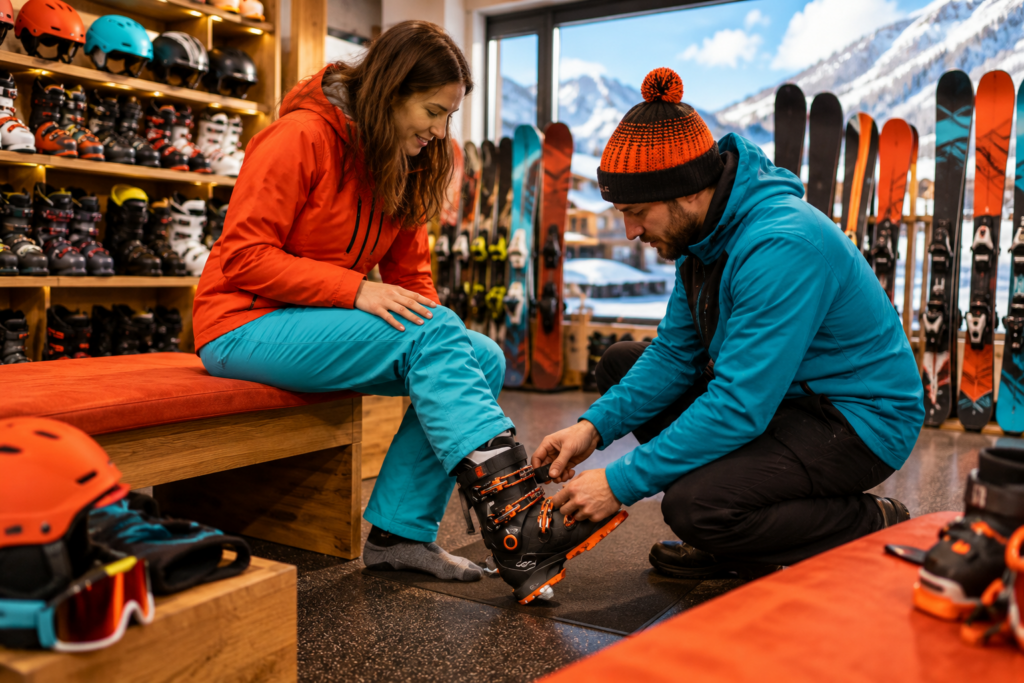
A thorough ski boot fitting at a reputable rental shop takes 10–15 minutes. Here is what should happen when you work with an expert boot fitter:
- Foot measurement — staff will ask for your Mondopoint size or measure your foot directly, noting foot shape, volume, and instep height
- Boot selection — the boot fitter will select suitable boots from the available range based on your measurements, skiing ability, and specific needs
- Shell check — they may remove the inner liner to check your foot sits correctly in the hard outer shell
- Buckle adjustment — all four buckles on a standard ski boot should be adjusted to your foot, not left on a default setting
- Stance test — you’ll stand and flex forward; staff check for heel lift and toe position
- Flex discussion — beginners benefit from a softer-flexing boot; it makes it easier to initiate turns without needing strong leg drive matched to your skiing ability
The fitting service should be free — it is part of the rental, not an add-on. If a shop hands you boots and points to a bench with no further assistance, that is a red flag.
Note: During busy periods — particularly school holidays and peak weeks in February and March — rental shops can get crowded. Some stores now offer ski boot fitting appointments, letting you book a specific time slot so you’re not waiting. It’s worth asking when you make your reservation, especially if you have specific needs like wide feet, custom insoles, or children requiring careful sizing.
Alpy.com partners with 1,150+ rental shops across 11 countries. With 12,000+ Trustpilot reviews at 4.7 stars, the quality of the in-shop fitting experience is one of the things customers mention most consistently.
Advanced Fitting Options: Custom Footbeds, Insoles and Liner Modifications
For most rental skiers, the standard fitting process is enough to find suitable boots that work well on the holiday. But if you ski regularly, have specific foot problems, or simply want maximum comfort on the slope, many rental shops and specialist boot labs offer additional services worth knowing about.
Custom footbeds and insoles
Most ski boots come with a basic flat insole that does little to support the natural arch or shape of your foot. Recommended insoles — or full custom footbeds — are moulded to the specific shape of your foot and placed inside the boot liner. They improve stability, reduce foot fatigue, and can eliminate pressure points caused by instep volume or arch shape. A boot fitter at a specialist store can advise whether an off-the-shelf insole or a fully custom footbed is right for you.
Heat moulding
Many modern ski boot liners contain foam that can be heat-moulded. The boot fitter places the liner in an oven to soften the foam, then you wear the boot while it cools, allowing the foam to settle around your specific foot shape for a tailored fit. This is one of the most effective ways to achieve maximum comfort without needing to purchase new boots — and some rental shops offer it as part of their service.
Liner modifications and stretching
If a boot is otherwise the right size but creates a pressure point at a specific spot — a bunion, a bony instep, or a wide forefoot — a boot lab technician can stretch or modify the shell at that point. This is more common when buying ski boots than when renting, but some high-end rental shops do offer it for customers who are unable to find comfortable boots from standard stock.
Pro Tip: If you’re based in the UK, several specialist ski boot fitting stores in London and other major cities offer pre-season fitting appointments before your ski holiday. Getting fitted at home means arriving at the resort with your boot selection already confirmed, and you can collect rental gear that matches your profile without spending half of day one at the counter.
Common Fitting Problems — and How to Fix Them
Toes go numb after 30 minutes Usually the lower buckles are over-tightened. Your heel stability and support comes from the upper buckles — the lower ones only need to be firm, not cranked. Ask staff to loosen the lower two buckles and retest.
Feet are freezing cold Almost always caused by boots that are too large. A loose boot traps less warmth and allows foot movement that restricts blood flow. Try half a Mondopoint size smaller. Also check you are wearing thin, knee-length ski socks — thick woolly socks add bulk and reduce circulation.
Shin pain (“shin bang”) after a few runs The boot is too stiff for your skiing ability, or the forward lean angle doesn’t match your height and stance. Ask the shop to swap to a softer flex or adjust the forward cant.
Heel lifts with every turn The boot is too large, or the liner has packed out and lost its shape. Rental liners settle over a season — if you’re unable to get the heel locked down even with buckles tight, ask for a freshly issued pair rather than stock that has already had heavy use.
Pressure point on the instep High-instep or high-volume feet can create a painful pressure point across the top of the foot. Ask the boot fitter to try a wider last boot from the range, or enquire about a quick heat stretch on the shell at that point.
Renting vs Buying Ski Boots: What’s Worth Knowing
For most skiers who holiday once or twice a year, renting ski boots is the more practical choice. Boot technology changes quickly, rental stock is regularly refreshed with new boots, and you avoid the cost, storage, and travel weight of owning a pair.
If you do decide to purchase new boots from a store, a few things to note: always get a proper fitting from an expert boot fitter before you buy, not after. New boots require a break-in period — the liner foam needs time to settle and mould to your foot shape. Check the store’s returns policy and your statutory rights before you commit, especially if buying online. And consider whether custom footbeds are worth adding at the point of purchase — it’s easier and cheaper to get them matched to new boots than to retrofit them later.
Note: Buying ski boots is a significant investment — a quality pair can cost £300–£700+. Renting gives you access to performance equipment matched to your skiing ability each season, at a fraction of that cost.
Kids’ Ski Boot Fitting: What Parents Need to Know
Children’s feet grow fast — often a full size between ski seasons. This is the main reason renting ski boots for children under 12 almost always makes more financial sense than buying.
Practical tips for fitting children’s boots:
- Use Mondopoint sizing — measure your child’s foot on the morning of the fitting, not from memory or last season’s size
- Children don’t always report discomfort when they’re excited. Before heading out, do the same flex-forward stance test you’d do for yourself — and make sure there’s no undue pressure on the instep
- Beginner children need the softest flex available — they don’t have the leg strength to match a stiffer boot
- Bring thin, knee-length ski socks from home — thick socks change the fit and cause pressure points
- Kids’ boot sizes are labelled in “J” sizes (J24 = 24 MP ≈ EU 38)
- When buying ski boots for children, always check the store’s guarantee and your statutory rights — children’s feet can change shape quickly and a boot that fits in October may not match in January
For a full checklist of what to bring on a family ski trip, our ski holiday packing list covers everything from socks and helmets to luggage tips.
FAQ
What is Mondopoint sizing for ski boots? Mondopoint (MP) is the universal sizing system for ski boots, measuring the length of your foot in centimetres. A size 26.5 MP fits a foot that is 26.5 cm from heel to the tip of the longest toe. To find your size, measure your foot standing on a hard floor and give that number to the rental shop — it is more accurate than converting from EU or UK sizes.
Should ski boots feel tight or loose when renting? Ski boots should feel snug, not painful. Standing upright, your toes should lightly touch the front of the boot. In ski stance (knees bent forward), they should pull back slightly. If there is visible space around your heel, or the boot rocks side-to-side when you twist your foot, it is too large. A properly fitted boot feels firm with good ankle support but should not cause pain or numbness.
Why are my feet cold in ski boots? Cold feet in ski boots almost always indicate the boot is too large, not too small. A loose boot allows foot movement that restricts blood circulation and traps less warmth. Try going down half a Mondopoint size. Also ensure you are wearing thin ski-specific socks — thick woollen socks create pressure points and reduce blood flow.
What are custom footbeds and do I need them? Custom footbeds are insoles moulded to your specific foot shape, placed inside the boot liner to improve stability, reduce fatigue, and eliminate pressure points. They are especially useful for skiers with high arches, high-volume feet, or pronation issues. A boot fitter at a specialist store can assess whether recommended insoles or a full custom footbed would benefit you — for occasional rental skiers, they are optional; for frequent skiers, they can make a significant difference to comfort and performance.
Can I book a ski boot fitting appointment in advance? Yes — many rental shops and specialist boot fitting stores offer ski boot fitting appointments, particularly useful during busy periods like school holidays. Booking ahead means you get dedicated time with an expert boot fitter, which is especially valuable if you have specific needs such as wide feet, a high instep, or are bringing children. Ask when you make your rental reservation whether the shop offers timed appointment slots.
Is boot fitting included in ski rental, or is it charged separately? At reputable rental shops — including all alpy.com partner shops — the fitting service is included in the rental price, not charged as an extra. Staff adjust buckles, check liner fit, and advise on flex index as part of the standard collection process. If a shop charges separately for fitting or rushes you through without checking fit, it is worth switching to a different provider.
What flex index should a beginner choose for ski boots? Beginner skiers should choose a flex index of 60–80. Lower flex means the boot bends forward more easily, making it easier to initiate turns without needing strong leg drive. Intermediate skiers typically use 80–100; advanced skiers 100 and above. Tell the boot fitter your skiing ability level and they will match you to the right flex from the available range.
Conclusion
Finding the perfect fit in ski boots is one of the most important things you can do before stepping onto the snow — and with the right fitting service, it costs nothing extra. Pay attention to the detail: foot shape, volume, instep, and flex all matter. A tailored fit means more stability, better performance, and a holiday where your feet stay warm and comfortable from first run to last lift.
Whether you are renting for the first time, bringing children to the mountains, or exploring custom insoles and footbeds for maximum comfort, the principles are the same: take the time at the counter, work with an expert boot fitter, and don’t leave the store with boots that don’t feel right.
Ready to book your ski or snowboard rental for 2026/27?
Alpy.com works with 1,150+ partner shops across Europe, with on-site fittings included as part of every rental. Customers save up to 65% compared to walk-in resort prices — book your ski or snowboard rental at alpy.com and collect from any partner shop at your resort.