

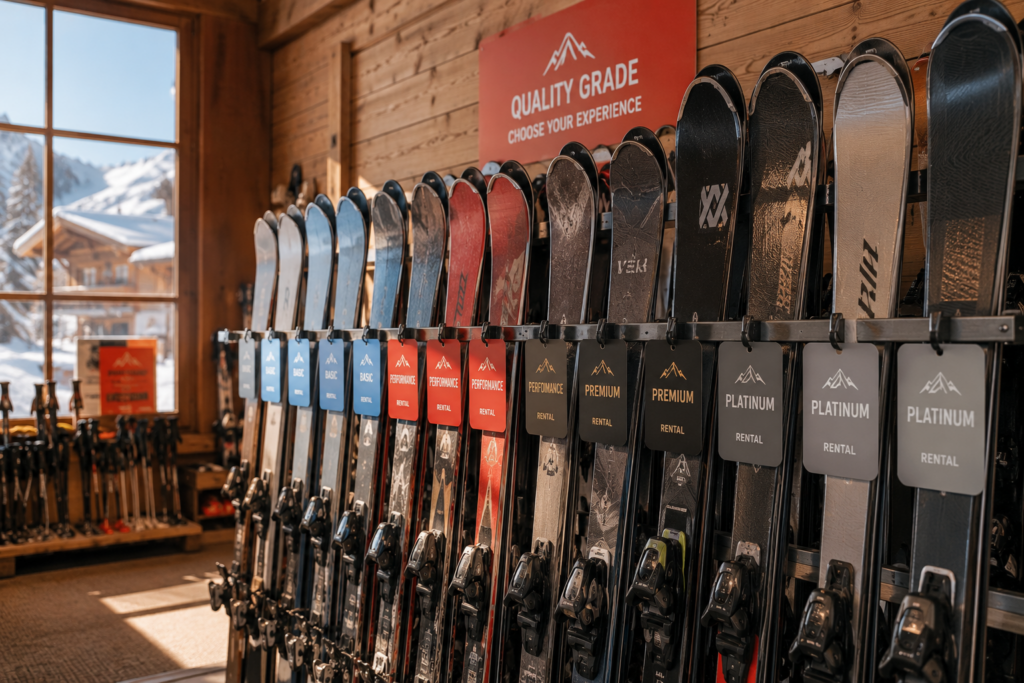
If you’ve ever stared at a ski rental page and seen “RED/SILVER,” “BLACK/GOLD” or “PLATINUM” next to a pair of skis with no idea what any of it means, you’re not alone. Most first-time renters assume these are just brand names or marketing labels. They’re not — they’re a standardised grading system that online ski rental, including alpy.com, uses to sort equipment by ability level and performance, the same way a hotel uses star ratings. Underneath each grade sits a specific model (or “equivalent model,” since exact stock varies by shop) — so “grade/model” together is really shorthand for “ability tier + the actual ski you’ll get.”
Getting the grade right matters more than most people realise. Book too low and you’ll spend the week fighting skis that can’t hold an edge on ice. Book too high and you’re paying for race-level construction you can’t yet use. This guide breaks down exactly what each grade means, what it costs, and how to pick yours with confidence before you ever set foot in a rental shop.
What Is Online Ski Hire?
Equipment hire online means booking your skis, boots, poles, snowboard or helmet in advance through a platform like alpy.com, rather than queuing at a shop counter on your first morning. You choose your resort, dates and equipment grade from home, enter your height, weight and shoe size so the shop can pre-set your bindings, then simply collect (or in some cases have delivered) your gear on arrival.
The grading system is what makes this work at a distance. Because “Red/Silver” or “Platinum” means the same thing at a partner shop in Sölden as it does in St. Anton, you can book equipment suited to your ability without seeing it in person first — which is the entire point of reserving online rather than gambling on whatever’s left on the rack when you arrive.
Ski Equipment Rental Grades Explained: Blue/Bronze to Diamond
Alpy.com’s partner shops use a five-tier star system, with categories commonly running from blue to red to black at many resorts, and equipment adapted across kids, teens, and adults. Every grade below has a men’s/unisex option and a Lady option, built on a women’s-specific last and typically lighter than the unisex equivalent — not just the same ski with a different sticker.
Each grade also lists a model — a named ski, such as “ATOMIC Cloud 12″or “BLIZZARD Stormbird 7.2,” followed by “or equivalent model.” That’s the shop telling you it stocks several skis of comparable performance within that grade, so the exact model can vary between shops and resorts even when the grade is identical. In other words: the grade is the promise (what level of ski you’re getting), and the model is which specific ski fulfils it at that shop.
Blue/Bronze — 3-star — Beginner Soft-flexing, forgiving skis designed to turn easily at low speed. This is the right starting point if you’re new to the sport or still finding your edges on greens and easy blues, and it’s usually the most economical choice for first-time skiers. Blue/Bronze Lady applies the same forgiving flex to a lighter, women’s-specific build.
Red/Silver — 4-star — Intermediate A step up in stability and edge grip for skiers who are comfortable on blues and starting to explore reds. Most shops also stock a shorter “mini ski” option within this grade for easier, playful turns. Red/Silver Lady follows the same intermediate spec on a women’s last.
Black/Gold — 5-star — Good skier Built for skiers who are confident, fast, and skiing reds and blacks regularly. Expect a stiffer flex and better high-speed stability than Red/Silver, in both the standard and Black/Gold Lady builds.
Platinum — 6-star — Excellent skier alpy.com’s own equipment guidance puts Platinum at “excellent skier and above” — this is performance-oriented equipment for skiers who are fast, technical, and comfortable in variable snow. Advanced skiers often choose premium or demo rentals for more performance, and those higher-end setups may also allow swaps during the rental period. Platinum Lady mirrors the spec on a lighter, women’s-specific construction.
Diamond — 7-star — Top tier The highest grade alpy.com offers, sitting above Platinum for expert and race-level skiers who want the most responsive equipment available to rent. Diamond Lady completes the range with the same top-tier spec built for women.
Alpy Tip: Not sure which grade to pick? Choose the one that matches your worst day on the mountain, not your best one. A confident intermediate on a groomed piste can still be caught out by ice or crud — Red/Silver forgives that; Platinum won’t.
How Much Does Each Grade Cost?
Exact prices move around a lot — by resort, by shop, by season, by group size, and depending the promotion alpy.com is running at the time for its newsletter subscribers — so there’s no single figure that holds true everywhere. What is consistent across almost every partner shop is the relative gap: each step up in grade costs noticeably more than the one below it, with Platinum and Diamond typically commanding the biggest premium over Blue/Bronze or Red/Silver for the same rental period.
Rather than fixating on a specific number, it’s more useful to think in relative terms: if budget is a priority, staying one grade lower than you’re tempted to book can make a real difference to your total trip cost without meaningfully changing your experience on the slopes. For a fuller picture of where rental fits into your total trip spend, see how much a ski holiday really costs.
How to Choose the Right Grade for Your Trip
Match the grade to how you actually ski, not how you’d like to ski by the end of the week: the right option should be suitable for how you really ski, while daily rentals suit holiday skiers heading out for a few days and longer-term options make more sense for repeat use.
- First time on snow, or skied fewer than 5 days total: Blue/Bronze
- Comfortable on blues, working on reds: Red/Silver
- Confident on reds and blacks, skiing multiple days a season: Black/Gold
- Fast, technical, skiing steep or variable terrain regularly: Platinum
- Race background or expert-level all-mountain skiing: Diamond
If you’re renting for a mixed-ability group — say, a family trip — it’s completely normal to book different grades for different people in the same order. A parent might book Black/Gold while their teenager books Red/Silver; the booking flow handles each person’s equipment separately. Season rentals are especially useful for families because children quickly outgrow equipment, and they let skiers keep gear for the whole winter season.
Online vs Walk-In Rental: What Changes When You Pre Book
The grades themselves don’t change whether you book online or walk into a shop — but your options and price do. Booking online means you select your grade and size in advance, your equipment is set aside, and you pay the online rate, which is consistently cheaper than walk-in pricing (up to 65% less versus in-resort prices for a full package). Walking in on the morning you want to ski means taking whatever’s left in your size and grade, at the higher in-store price, with no guarantee your first-choice grade is still in stock during a busy week.
Frequently Asked Questions
What do the colour names like “Black/Gold” or “Red/Silver” actually mean? They’re grade names, not brand names. Each pairs a star rating (from 3-star to 7-star) with an ability level, so “Black/Gold” always means 5-star, good-skier ski equipment regardless of which shop or resort you’re booking with.
What’s the difference between the grade and the model on a rental listing? The grade (like Red/Silver) is the ability tier — it tells you the ski’s performance level. The model (like “BLIZZARD Stormbird 7.2 or equivalent model”) is the specific ski you’ll actually get within that grade, and partner shops may stock different brands within the same grade, so the exact model can vary slightly between shops even when the grade is the same.
Is Platinum or Diamond always better than Blue/Bronze? Better for the right skier, not better in general. Higher grades are stiffer and less forgiving — great for control at speed, harder to turn easily at low speed. Choosing the right equipment for your level matters more than simply picking the highest tier. A beginner on Diamond skis will have a worse time than a beginner on Blue/Bronze.
What does “Lady” mean on a rental listing? It’s a women’s-specific version of that same grade, built on a different last and usually lighter than the unisex/men’s ski at the same star level — not a separate, lower-performance category.
Can I change my grade after I’ve booked? Usually yes. Downgrading within your booking period is typically free; upgrading means paying the difference at the shop’s walk-in price. Booking the “model change” add-on in advance makes swapping grades during your trip easier if conditions change, and shop staff can usually help with the change as part of the in-resort service.
Do boots and helmets use the same grading system? Boots are generally matched to the ski grade you select as part of a package, and fit is based on your shoe size rather than a separate star rating. Helmets and other accessories are sized rather than graded, and are included with your gear — Alpy Tip: skip buying one altogether, since every alpy.com rental includes a properly fitted, certified helmet, covered by ALPINGUARANTY.
Conclusion
Ski rental grades exist to solve a simple problem: matching unfamiliar equipment to your actual ability before you arrive at the resort. Once you know that Blue/Bronze means beginner and Diamond means expert — with Red/Silver, Black/Gold and Platinum in between, each with a Lady equivalent — the whole booking process stops being guesswork. Pick honestly, not aspirationally, and you’ll spend more of your trip skiing and less of it fighting your gear in the mountains.
Ready to book? Compare partner shops and book your ski or snowboard rental now at some of the best ski resorts → Save up to 65% compared to walk-in resort prices, with free cancellation until the day before your rental starts, backed by 12,000+ Trustpilot reviews at 4.7 stars. Compare partner shops and book your ski or snowboard rental